Hegseth proposes US-ASEAN defence framework at Cebu meeting
The US defence secretary pitched a new cooperation framework to Southeast Asian ministers as Australia joins related security talks in the Philippines.
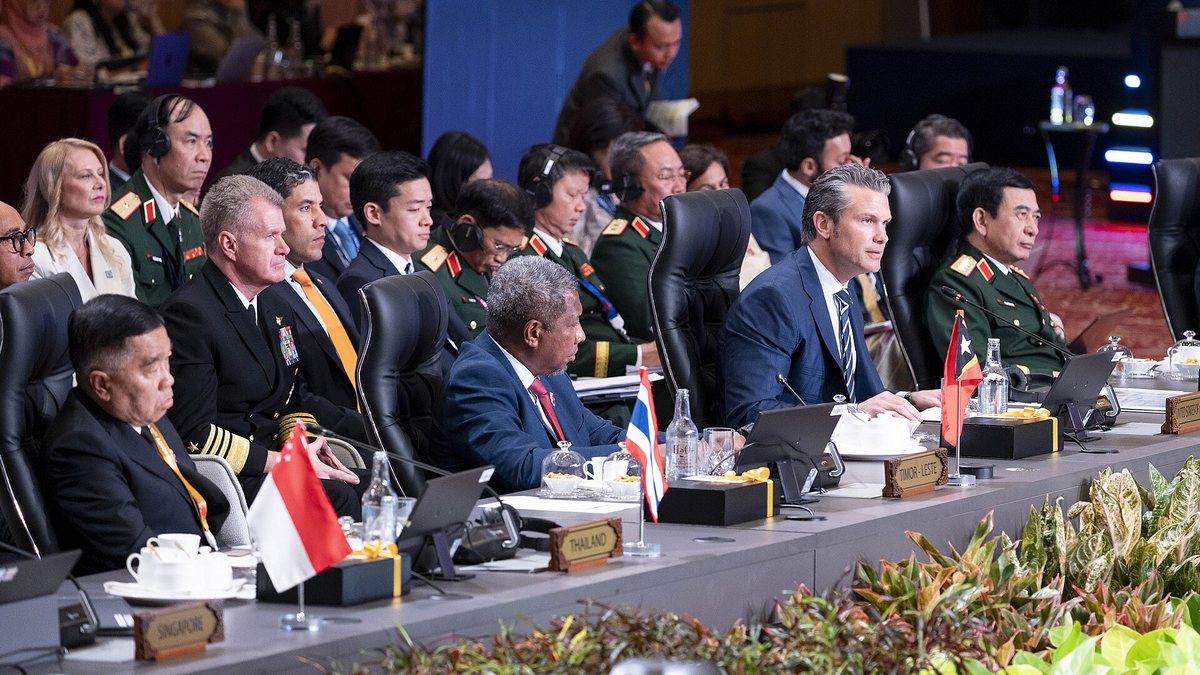
US Defense Secretary Pete Hegseth has proposed a new US-ASEAN framework for defence cooperation. He told Southeast Asian defence ministers in Cebu, in the Philippines, on Wednesday (Oct 28) that it would guide ties over a "critically important next several years". CNA and The Hindu reported that he gave no details of what the framework would contain.
Australia is part of the wider talks. The Straits Times reported that defence chiefs of the Squad, an informal grouping of the US, Japan, Australia and the Philippines, were due to meet on Wednesday. Hegseth is also set to join an expanded defence ministers' meeting on Thursday with ASEAN's 11 members and eight partners, among them Australia, China, India, Japan, New Zealand, South Korea and Russia.
"As we look to the future in this region, I'd like us to be even more ambitious," Hegseth said, according to CNA. He said Washington was ready to start work on the framework as Singapore takes over the chairmanship of the ADMM-Plus grouping in the coming year. The Straits Times and the South China Morning Post noted that 2027 marks 50 years of relations between the US and Southeast Asia.
Hegseth praised the region's "pragmatism" and "proud nationalism" and called for stronger maritime domain awareness and closer cooperation between navies. "We're not going to agree on everything, nor do we need to," he said. "These are not symbolic things. They are concrete demonstrations of what serious partners do."
The Straits Times reported that his visit comes as governments in the region weigh whether Washington can stay focused on the Asia-Pacific while the Iran war strains US military resources. Hegseth described the US approach as "strong, quiet and clear". "We will defend our interests and the interests of our allies and partners. That is, by definition, peace through strength," he said.
Whether ASEAN will sign up is uncertain. The South China Morning Post said analysts expect members to prefer bilateral arrangements that keep their flexibility in dealing with Washington and Beijing. Greg Poling, director of the Asia Maritime Transparency Initiative, told The Straits Times he expected "tactical cooperation on the ADMM workstreams ... but no strategic alignment on the South China Sea or other thorny issues". Collin Koh of Singapore's S. Rajaratnam School of International Studies said Manila's position as ASEAN chair while in a dispute with China was "particularly sensitive".
Manila said this month that China's military and coast guard presence in contested areas of the South China Sea nearly doubled in September, CNA reported. The Straits Times said the Philippine military shadowed China's Liaoning aircraft carrier group days before the meeting as it passed off the southern Philippines towards the Celebes Sea.
On the sidelines, Japanese defence chief Shinjiro Koizumi met Hegseth. According to CNA, the two discussed implementing "an effective denial defence in the First Island Chain" and committed to "close coordination" on munitions production.
China's defence ministry said on Oct 27 that its defence attache in the Philippines would attend the Cebu meeting.
Sources: CNA, Hegseth proposes 'ambitious' US-ASEAN defence framework at Philippine summit; South China Morning Post, Hegseth pitches US-Asean defence framework but will it be a hard sell?; The Hindu, Hegseth proposes 'ambitious' U.S.-ASEAN defence framework at Philippine summit; The Straits Times, Hegseth reassures South-east Asia of US commitment, pledges stronger defence ties.