 www.asiatimes.com.au News and Views from Asia Pacific
- The Vice President of India Shri M Venkaiah Naidu said that a steady growth rate of almost 7% coupled with a series of reforms made India, the most favourite destination for investments in the world. Shri Naidu said that it was the right time for foreign investors to tap the huge potential offered by India in various sectors from real estate to healthcare.
- Shri Naidu said that government’s initiatives and reforms helped India achieve 11th rank in the Global FDI confidence index 2018. Referring to a report by UBS, he said that the annual FDI inflows would rise to $ 75 billion over the next five year and added India with its growth momentum would soon become $5 trillion economy.
- Describing India as a bright spot in the world economy, he said India would continue to be the fastest growing major economy in the world, quoting the World Bank’s latest forecast. It said the GDP is expected to grow at 7.3 per cent this fiscal year and at 7.5 per cent in the following two years.
- Shri Naidu said that the robustness of India’s institutions, resilience of its policy frameworks, the reforms initiated by the government and the responsiveness of Industry bodies such as CII have insulated its economy from stagnation and helped in achieving the dual distinction of being a stable democracy and one of the fastest growing economies in the world.
- Lauding the efforts of government and its agenda to reform processes for the betterment of administration, Shri Naidu said that such reforms were the need of the hour and would continue.
- The Vice President also appreciated the healthy competition among various states to attract investors and promote industrialization. He urged the state governments to promote similar competitiveness among districts to realize rural India’s full potential.
- Referring to the construction of airports under Public-Private Partnership model in Hyderabad, Delhi, Bengaluru and Mumbai, Shri Naidu said that it was the way forward for effective implementation of infrastructure projects.
- Urging the industry to supplement the efforts of the governments in improving lives of people living in villages, Shri Naidu observed that the increasing internet penetration in rural India provides a great opportunity to improve rural India. Connecting all Gram Panchayats with optical fibre network under the BharatNet project by March 2019 would transform rural India by enabling access to digital transactions and online sales of products, including agri produce via e-Nam.
- The Vice President called for a special focus on Agriculture and said farmers must be trained and educated on diversification of crops, Zero Budget Farming, investing in allied activities like fisheries, horticulture and others to make the sector more inclusive, profitable and sustainable.
- Shri Naidu advised the industry to promote innovation and invest more time and money in Research and Development. He wanted the industry bodies like the CII to promote business ethics, values, transparency and accountability. He said that they should also try weed out black sheep who bring a bad name to the business community.
- He called upon the business community to share more and more of their wealth through Corporate Social Responsibility initiatives to address challenges like poverty, illiteracy, double burden of infectious diseases and non-communicable diseases and unemployment. The Vice President also urged the private sector to provide equal opportunity to employees and not to practice discrimination against women in any form. Let women empowerment and gender equality be among the founding principles of all Indian businesses, he added.
- Talking about the importance of Skill development to realize India’s demographic dividend, the Vice President urged the private sector to step up its skilling programmes to enable youth to stand on their feet.
- Referring to terrorism, he stressed the need for the United Nations to conclude at the earliest the Comprehensive Convention on International Terrorism and said that terrorism was a global concern that demands global attention and requires global cooperation. Terror is enemy of humanity, we must see to it that is eliminated the earliest, he added. He also wanted the world community to ensure that economic fugitives get extradited without delays.
- Shri Naidu also urged the nations across the globe to work closely to overcome challenges such as poverty and illiteracy. With an aim to showcase a New India, the summit is being organised by Department of Industrial Policy and Promotion, Ministry of Commerce and Industry, Maharashtra Government and Confederation of Indian Industry. Over 1,000 delegates from 40 countries converged in Mumbai city to attend the 25th edition of Confederation of Indian Industry (CII’s) Partnership Summit that is be based on the theme, New India: Rising to Global Occasions.
- The Governor of Maharashtra, Shri C. Vidyasagar Rao, Union Minister of Commerce and Industry, Shri Suresh Prabhu, The Minister for Industries & Mining, Government of Maharashtra, Sri Subhash Desai, Minister for Trade, Industry and Energy, Republic of Korea, Mr. Kim Hyun-chong, Minister of Economy of UAE Sultan bin Saeed Al Mansoori and Director-General of World Intellectual Property Organisation Francis Gurry were also present at the inaugural session.
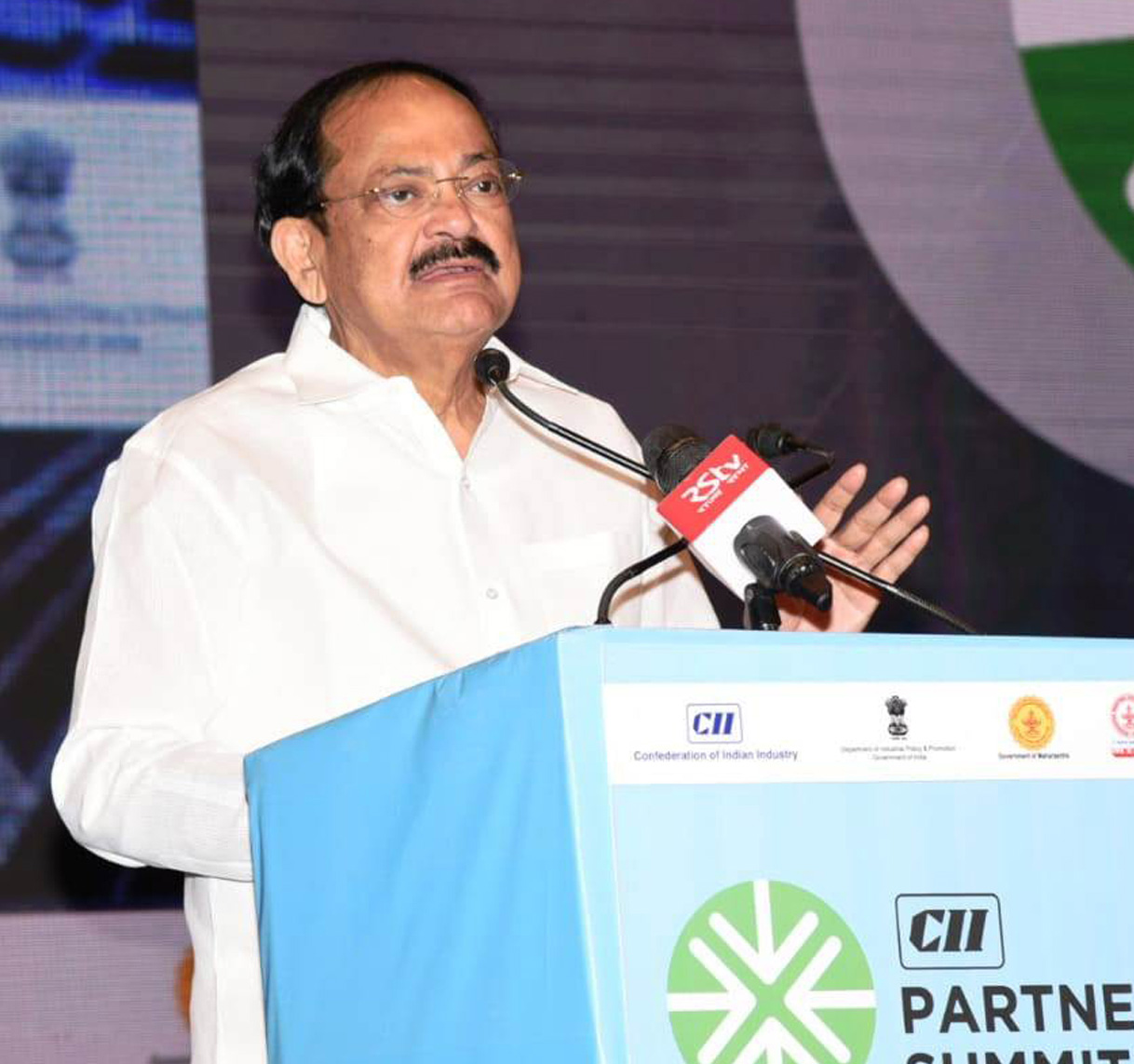
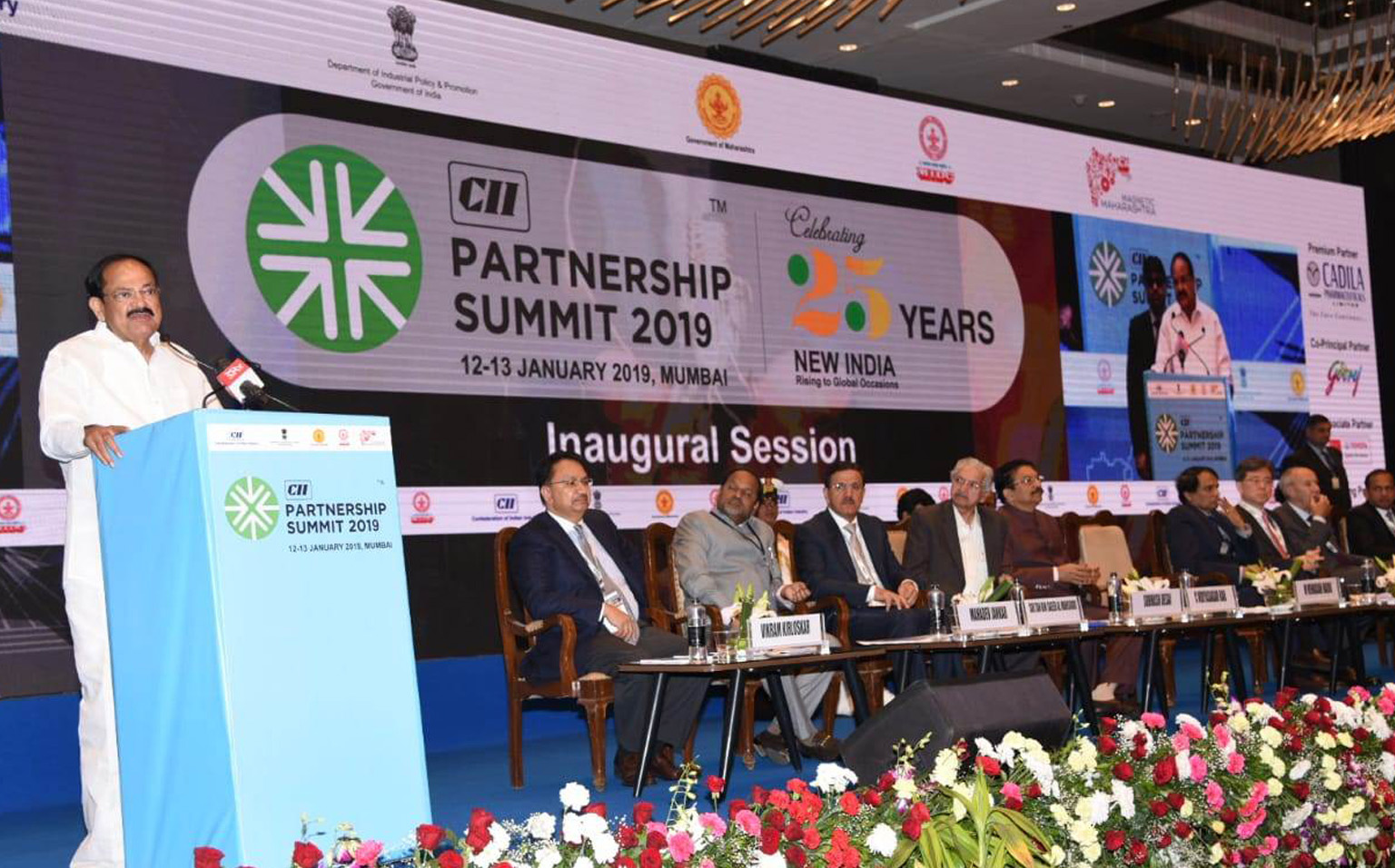
The Governor of Maharashtra, Shri C. Vidyasagar Rao, the Union Minister for Commerce & Industry and Civil Aviation, Shri Suresh Prabhakar Prabhu and other dignitaries are also seen.
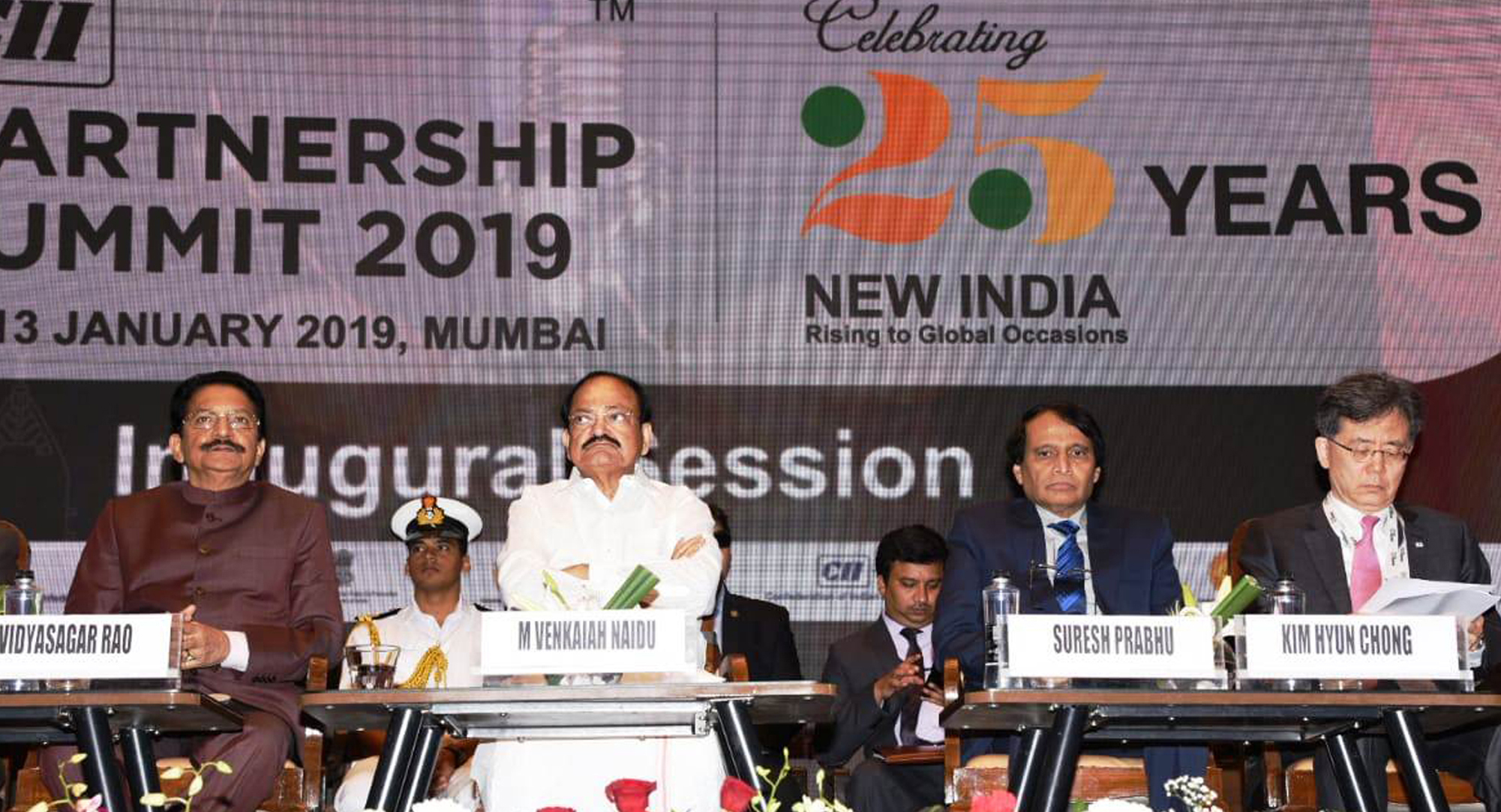
The Governor of Maharashtra, Shri C. Vidyasagar Rao and the Union Minister for Commerce & Industry and Civil Aviation, Shri Suresh Prabhakar Prabhu are also seen.
- Full Text of Speech:
- “ It is indeed a pleasure to be addressing Confederation of Indian Industry‟s Partnership Summit being held in collaboration with the Department of Industrial Policy and Promotion and the Government of Maharashtra. I am glad that summit is being held in Mumbai, the trade, commerce and financial capital of India.
- It is heartening to note that CII plays a proactive role in India's development process, pioneering several initiatives which inspire competitiveness and create innumerable business opportunities. I am also happy to note that important topics such as „Partnering with New India‟, „Reforms and de-regulation‟, „The Infra expanse—A Super Imperative for Growth‟, „Shaping the Future of Manufacturing: The Time is Now‟ and „Giving the Food and Agro Sector the much needed impetus‟ are being discussed at the summit.
- Sisters and brothers,
- Indian economy has been writing a fascinating growth story over the last decade. Even when the world went into a slow down, India endured and kept its economy from slumping. The robustness of India‟s institutions, the resilience of its policy frameworks, the reforms initiated by the government and the responsiveness of Industry bodies have successfully insulated its economy from stagnation.
- Today, India has achieved the dual distinction of being a stable democracy and one of the fastest growing economies in the world. Over the last decade, within a subdued global environment, India has enjoyed a growth rate of almost 7%, touching close to $3 trillion GDP. The World Bank in its latest forecast has said that India will continue to be the fastest growing major economy in the world. It said the GDP is expected to grow at 7.3 per cent this fiscal year and at 7.5 per cent in the following two years. In the coming years, the size of the Indian economy is expected to touch $5 trillion which would further double to $10 trillion by 2030.
- In the wake of various initiatives and reforms taken by the Government in the past few years, India has become one of the favourite destinations for investments in the world. India was ranked 11th in the Global FDI confidence index 2018. The annual FDI inflows in the country are expected to rise to $ 75 billion over the next five years, according to a report by UBS. In fact, this is the right time for foreign investors to tap the huge potential offered by India in various sectors from real estate to healthcare. India is the bright spot in the world‟s economy today.
- Forward-looking taxation reforms like the introduction of Goods and Services Tax (GST) have converted India into an integrated market. Other noteworthy reforms include the implementation of Bankruptcy and Insolvency Code. India improved its rank by 23 positions in the World Bank‟s Ease of Doing Business and was placed at 77th rank among 190 countries.
- A World Economic Forum report has stated that with more than three-fourth of Indian households expected to be in the middle-income category, consumer spending is expected to quadruple to Rs 420 lakh crore from the current Rs 105 lakh crore by 2030, making India the third-largest consumer market.
- The consumption will be driven by a burgeoning middle class and the emergence of a sizeable high-income segment. However, what is important is the report‟s forecast that less than five per cent of Indian households will lie below poverty line.
- The income and consumption trends will be led by Kerala, Karnataka, Andhra Pradesh, Telangana and Tamil Nadu in the south; Delhi, Haryana and Punjab in the north; and Maharashtra and Gujarat in the west, the report said.
- The Indian consumer market has huge untapped potential. Rising disposable incomes and favourable demographics are attracting global corporations to the Indian market. Today India is the second largest mobile phone manufacturer.
- With the Government implementing a comprehensive reform agenda to attract private investments and promote market freedom, most sectors are now open for 100% foreign participation through FDI under the automatic route. In recent years FDI regulations have been enhanced in certain crucial sectors including insurance, defence manufacturing, real estate and railways.
- In the financial sector, regulations have been strengthened by the SEBI and the RBI. Increased capital has been infused into public sector banks. Stringent measures have been taken to address the problem of non-performing assets and to get the credit pipeline flowing freely.
- New investment platforms such as National Infrastructure Investment Fund, Higher Education Funding Agency, Infrastructure and Real Estate Investment Trusts and others have been set up. The concerns which foreign companies had about the protection of Intellectual Rights have also been addressed through the new National Policy on IPR.
- As a matter-of-fact, the series of economic and administrative reforms undertaken by Indian Government have not only added more tax payers but also enabled the government to bring down tax rates, apart from improving the way business is done. Various reforms are also aimed at making the economy inclusive.
- The policy initiatives taken by the Indian government such as Make in India, Skill India, Digital India, Smart Cities and Start-up India are opening up new opportunities. Measures such as Startup India and Stand-up India are helping the youth to become job creators instead of ending up as job seekers. Conferring infrastructure status to the Housing sector, implementation of RERA, Housing For All Scheme and lowering the interest rates are steps in the right direction. Increasing internet penetration is opening new opportunities for people living in rural areas. Sale of goods and services online is picking up in rural areas too. 1.21 lakh Gram Panchayats are connected with optical fibre network under the BharatNet project and the remaining gram panchayats would be connected by March 2019. This will transform rural India by enabling access to digital transactions and online sales of products, including agri produce via e-Nam.
- I am particularly happy to note that various states in the country, even when governed by different parties, are competing among themselves in a healthy manner to attract investments, both domestic and foreign, by offering incentives and concessions in different sectors. Such healthy competition will make the States to adopt the best practices and promote a conducive business environment. I feel that similar competition should be promoted among districts within a State.
- I also feel that simplifying rules, removing discretionary powers and decentralization will play a key role in quickening the pace of development. As a matter of fact, States should encourage local bodies to function effectively by providing the three Fs—funds, functions and functionaries.
- Dear sisters and brothers, we should strive to further nourish and sustain all our strengths to face challenges that would soon be coming our way. Indian industry has always played an important role in developing an environment that enables companies to conduct business activities across borders freely and smoothly. Thus, forging new and more meaningful partnerships and value chains in the international market becomes an imperative for India.
- Sisters and brothers,
- The government has enhanced public investments in sectors such roads and highways, ports, airports and inland waterways, inspiring great hope and confidence. It is also heartening to note that, India, today, is the fastest growing market in the telecom sector and it has benefited greatly from government policies.
- The creation of the National Digital Communications Policy, which will attract $100 billion of investments, has endowed this sector with the much needed policy backing. Looking ahead, the Niti Aayog in its recent report, „Strategy for New India @ 75‟ talks about certain steps that need to be taken to achieve a robust growth rate which, it believes is essential for generating sufficient jobs and achieving prosperity for all.
- Four key steps have been spelled out for achieving growth-- Increasing the investment rate, Creating a unified national market in the agriculture sector, Promoting the „Zero Budget Natural Farming‟ (ZBNF) that promotes sustainable agriculture and the completion of the Codification and reform of labour laws. I also feel that agri-insurance rates need to be made more attractive. I am sure that these will form the cornerstone of the Government of India‟s strategy going forward. Let me use this opportunity to share with you a few areas that we should lay greater emphasis on to achieve inclusive and sustainable development.
- Agriculture should be our prime area of focus. As you all are aware, agriculture is the backbone of Indian economy. It is the primary source of livelihood for nearly 60 per cent of the population. The agriculture has to be made profitable and sustainable and the farmers have to be encouraged to diversify into allied activities like poultry, horticulture and fishing to ensure sustainable livelihood. With value addition, the Indian food processing industry and horticulture have immense scope for expanding its footprint. With population increasing day-by-day, I have been emphasizing time and again that India cannot sustain on imported food security.
- Only a well nourished and healthy nation can be a wealthy nation. Therefore we must increase the resilience of our agriculture and make it a much more rewarding profession for our farmers. We must resort to organic methods of farming and practice and promote the judicious use of inputs and irrigation. We should also strive to promote innovation and invest more time and money in Research and Development. We need to promote grown food security. Our innovations need not be complex and ground breaking. They could very well be frugal and simple. But they should be capable of addressing the everyday problems of the common man. Science and technology should ultimately result in the betterment of human condition.
- I also implore industry bodies like the CII to promote business ethics, values, transparency and accountability. Bodies like CII should also try weed out black sheep who bring a bad name to the business community.
- Sisters and Brothers,
- Let me remind you that India is at the cusp of a demographic dividend. I sincerely believe that the youth of India possess all the qualities required to lead this country to prosperity. However, the need of the hour is to impart them with skills and provide them with opportunities so that we can reap this demographic dividend. The private sector needs to step up its skilling programmes to enable youth to stand on their feet.
- I also urge the private sector to be equal opportunity employers and to not practice discrimination against women in any form or any level. Let women empowerment and gender equality be among the founding principles of all Indian businesses.
- India has a billion dreams to nurture, nourish and take to fruition. I hope that Indian Industry will be an equal partner in India‟s quest for sustainable and inclusive development. I congratulate the CII for conceiving this Partnership Summit, which I understand, is a Global platform for dialogue, debate, deliberation and engagement among Indian and global leaders on economic policy and growth trends in India. Such summits and exchanges are crucial for us to learn from one another, understand the best practices from around the globe and share knowledge and practical wisdom.
- I hope that this summit serves as a launch pad for the dreams of Indian Industry in 2019.
- I wish the Summit and all its organizers and Participants all the very best.
- Jai Hind! ”